Claude Fable 5 Can Quietly Swap Itself for a Weaker Model: A Governance Problem
Claude Fable 5 is the most capable model Anthropic has released to the general public, and a genuinely useful one. But when its safety classifiers judge a request as touching a restricted topic like cybersecurity or biology, it can silently route that request to a weaker model (Opus 4.8) and return the result as a normal HTTP 200 success. By Anthropic's own admission, ordinary error-monitoring never sees the swap. For any organization that must evidence which model processed which data under ISO 42001, the NIST AI RMF, or the EU AI Act, that silent substitution is a governance problem, not a capability footnote. The answer is not avoidance. It is treating model selection, refusal logging, and vendor AI use as assessable controls before Fable 5 goes near a client tenant.

On June 9, 2026, Anthropic released Claude Fable 5, which it describes as its “most capable widely released model, built for the most demanding reasoning and long-horizon agentic work.” It is, in Anthropic’s own framing, “a Mythos-class model that we’ve made safe for general use,” and one that “exceeds any model we’ve ever made generally available.”
The headline writes itself, and most of the coverage has written it: the most powerful public model yet, priced at a premium, with benchmark scores to match. That part is true and worth taking seriously. But for the organizations that have to govern AI rather than simply use it, the more important detail is not in the benchmarks. It is in how Fable 5 behaves when it decides a request is too sensitive to answer. That behavior introduces a problem almost none of the launch coverage has touched.
The story so far: Glasswing, Mythos, and the two twins
If the phrase “Mythos-class” sounds familiar, it should. In April, Genesis covered Project Glasswing, the coalition of twelve infrastructure giants Anthropic assembled around an unreleased frontier model called Claude Mythos Preview. That model can find zero-day vulnerabilities at machine speed, and Anthropic said plainly it would not release it to the public.
Fable 5 is the next chapter of that story, and the family tree is the key to understanding the problem.
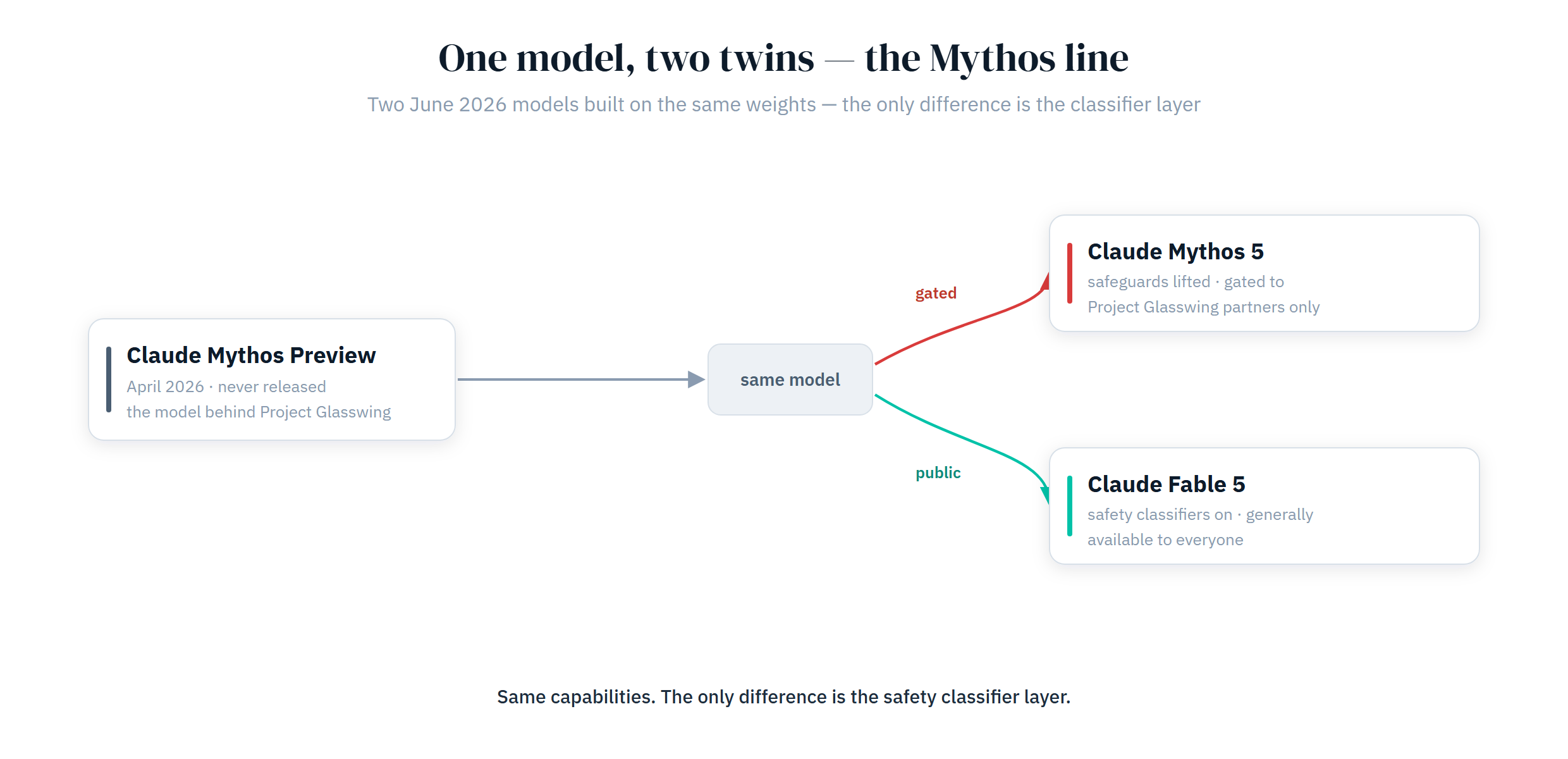
According to Anthropic’s own documentation, Fable 5 and Claude Mythos 5 are the same underlying model. Mythos 5 is the productized successor to Mythos Preview. The difference between them is a layer of safety classifiers: Mythos 5 has its safeguards “lifted in some areas,” and remains available only in limited release to Project Glasswing partners. Fable 5 keeps the safeguards on and is sold to the general public.
So there are now two twins descended from the same frontier model. The unguarded, full-capability twin is gated to a dozen of the largest organizations on earth. The guardrailed twin is the one anyone can buy. The naming even nods to the relationship: Anthropic notes that Fable derives from the Latin fabula, “that which is told,” a sibling of the Greek mythos. Same root, two stories.
That guardrail layer is the whole subject of this piece. It is also the reason Fable 5 is genuinely useful and the reason it is hard to govern. Those two are not in tension. They are the same fact seen from two sides.
What Fable 5 is, and where it earns its price
Before the criticism, the credit, because it is deserved.
Fable 5 sits above the Opus tier. It is the new ceiling on what Anthropic offers the public. It ships with a 1 million-token context window and up to 128,000 output tokens per request, and Anthropic reports state-of-the-art results across nearly all the benchmarks it tested, with particular strength in long-horizon agentic execution, complex coding, and knowledge work: the multi-step, tool-using tasks where earlier models tended to lose the thread.
For the businesses MSPs and vCISOs advise, those capabilities are not abstract. A model that holds a million tokens of context and carries a complex task across dozens of steps without supervision is genuinely valuable for code migration, contract and document analysis, and the agentic workflows that were brittle even six months ago. It is available through the Claude API, Amazon Bedrock, Google Vertex AI, Microsoft Foundry, and AWS, so it will reach client environments through more than one door.
It is also expensive. List price is $10 per million input tokens and $50 per million output tokens, exactly double Opus 4.8. Anthropic is offering it free to Pro, Max, Team, and Enterprise subscribers only through June 22, 2026, after which it draws on usage credits. The pricing is itself a signal: Anthropic is gating access by cost even for the safe twin.
When Fable 5 is the right call. For latency-tolerant, high-value work that stays clear of the restricted domains (large-scale code refactoring, research synthesis, document review, complex agentic automation), Fable 5 is a defensible upgrade, and the governance concerns below are manageable with the right logging in place. The argument here is not “avoid it.” It is “know what you are deploying before you point it at regulated data.”
The detail in the fine print
Fable 5 includes a layer of safety classifiers that Mythos 5 does not. Per Anthropic’s documentation, those classifiers cover four categories: cyber, bio, frontier_llm, and reasoning_extraction. They span cybersecurity, biology, frontier-model capability transfer, and attempts to extract the model’s hidden reasoning.
The behavior that matters is subtler than a plain refusal.
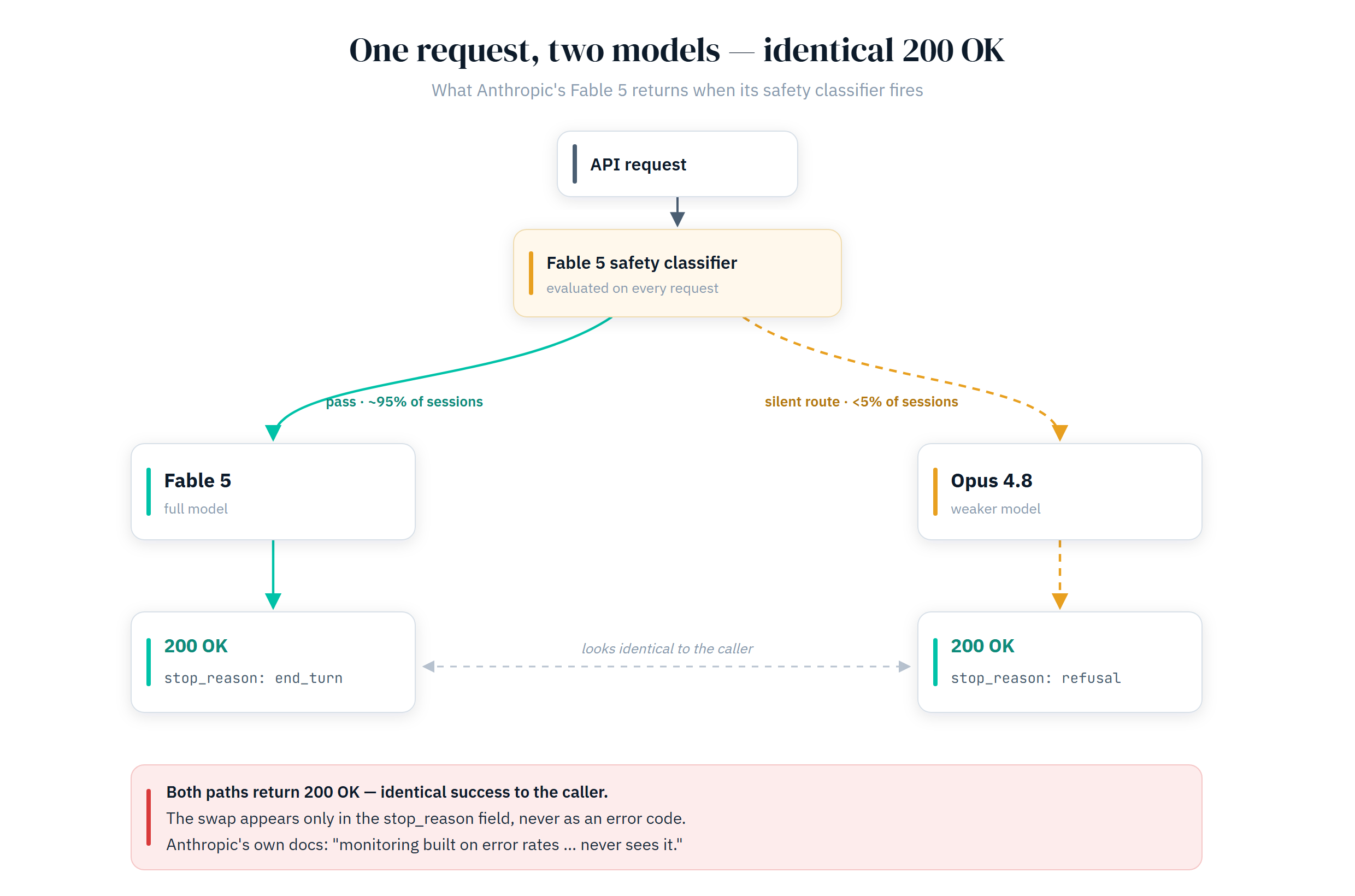
What happens when a classifier fires depends on where Fable 5 is running, and either way the result comes back looking like success. On Anthropic’s consumer plans (Pro, Max, Team, Enterprise), the request is automatically handed to Anthropic’s next-most-capable model, Claude Opus 4.8, and the user is never asked. On the Messages API, the default is actually to refuse outright. Critically, that refusal is returned as a normal HTTP 200 with a stop_reason of refusal, not an error code, and developers can opt in to the same silent Opus-4.8 fallback. Anthropic says the classifiers trigger in “less than 5% of sessions.”
The consequence is easy to miss precisely because nothing breaks. Anthropic says so itself. Its developer documentation states that “a refusal is an HTTP 200, so monitoring built on error rates or 5xx responses never sees it.” When the classifier fires on a consumer plan, a different, less capable model answers and the user is none the wiser. On the API, unless the integration inspects the stop_reason field, a naive pipeline sees 200 OK and a plausible answer and moves on. Anthropic even instructs developers to build the visibility themselves, to “emit one event per refusal and one per fallback-served response… then alert on the gap between the two counts.” Read that plainly: the burden of seeing the swap is on you. And in the consumer apps your staff actually use, there is no switch to turn it off. The unguarded model that skips the classifiers is Mythos 5, which only Glasswing partners can buy.
This is categorically different from a refusal. A refusal is visible: the model declines, the caller knows it declined, and the caller handles it. A silent substitution is the inverse. The work gets done, by something other than what was specified, and the only evidence is a field most teams are not watching.
Why “it’s still Opus 4.8” misses the point
The obvious rebuttal is that Opus 4.8 is not a weak model. Until June 9 it was the most capable model Anthropic sold. If the fallback hands your request to last week’s frontier, how bad can it be?
Half right, and that is exactly why this is a governance problem rather than a quality scare. Here is what actually changes when a request drops from Fable 5 to Opus 4.8.
| Claude Fable 5 (what you asked for) | Claude Opus 4.8 (the silent fallback) | |
|---|---|---|
| Tier | Mythos-class, the new top of the public lineup | The prior flagship, now the fallback target |
| Capability | Anthropic’s most capable public model; it reports beating Opus 4.8 across reasoning, coding, and agentic work, with the lead widening on longer tasks | Still excellent, the public frontier until June 9, a tier below Fable 5 on those tasks |
| Price (per million tokens, in / out) | $10 / $50 | $5 / $25 |
| Context / max output | 1M / 128K | 1M / 128K |
| Safety guardrails | A Mythos-class classifier layer scans every request for cyber, bio, frontier_llm, and reasoning_extraction content and falls back to Opus 4.8 on a hit | Standard safety training and Usage-Policy enforcement; no topic-classifier layer |
| Data retention | ”Covered Model”: mandatory 30-day retention, no zero-data-retention option | Standard retention; ZDR available to eligible customers |
The capability step is real, and Anthropic does not undersell it: it reports Fable 5 is the first model to clear 90% on its long-running analytics benchmark, a 10-point jump over Opus 4.8, and 25 to 30 percent faster on spreadsheet work. But Opus 4.8 was the public frontier a week ago, so for most requests the gap a user would notice is small. The rows that should give a governance team pause are the others: you are paying for the top tier and, on some requests, being served the one below it; the guardrail layer that defines Fable 5 is the very thing that pulls you off it; and the retention posture of the request can differ from the model you thought you were using.
The deepest problem is not any single row. It is that the substitution is silent, unchosen, and inconsistent. You did not decide to use Opus 4.8 for that request, and nothing in the response tells you it happened. Your documented system says Fable 5, and for some fraction of requests that documentation is simply wrong. The same prompt can be answered by Fable 5 today and Opus 4.8 tomorrow, depending on whether the classifier fires.
Three places this shows up, and none of them is a story about a bad answer.
The assessment that will not reproduce. A compliance workflow uses Fable 5 to draft control-test narratives for a client’s ISO 42001 evidence pack. Run the prompt on Monday and Fable 5 answers it; run it Thursday and the classifier fires, so Opus 4.8 answers instead. Both narratives may be perfectly good. They are also different, and when the auditor asks why the same control was assessed two ways, “a different model happened to answer, and we did not log which” is not a sentence that survives the room.
The commit you cannot attribute. A developer uses an internal Fable-5-backed assistant to write and review code. The security-sensitive pieces (the auth flow, the input-validation fix, the crypto helper) are exactly what trips the cyber classifier, so Opus 4.8 produces them. Months later, a code review or a post-incident analysis asks which model wrote a given change and on what reasoning. The answer is gone, because the one field that recorded the swap was never captured. The code may be fine. Its provenance is not.
The inventory that no longer matches reality. An MSP lists Fable 5 in its client’s AI system inventory and documents the controls around it. In practice, a slice of every day’s requests were served by Opus 4.8, and the integration never logged the stop_reason that would have shown it. When the auditor compares the inventory to the traffic, the two do not agree, and “we thought it was always Fable 5” is now a finding rather than a footnote.
None of these is a story about a bad answer. Each is a story about not being able to say which model did the work. And every one is fixable the moment you know the swap exists: log the refusals, record which model answered, and decide in advance where the fallback is acceptable and where it is not. The danger is not the model. It is not knowing.
Why a silent model swap is a governance problem
For a consumer, the occasional down-route to a slightly weaker model is a minor annoyance. For an organization that has to evidence its AI use, which increasingly means any organization with regulated clients, it is harder to wave away. The frameworks that govern AI all rest on one shared assumption: that you know which system makes decisions on your data, and that you can produce a record of it. Fable 5’s design quietly undermines that assumption.
The table below maps the mechanism. The honest reading is that two of these frameworks bite hard and one is softer than the launch-day alarm might suggest. Saying so is what keeps the argument credible.
| Framework | Status | Relevant obligation | Why the silent swap trips it | How hard it bites |
|---|---|---|---|---|
| ISO/IEC 42001 | Voluntary international management-system standard | Event logging (A.6.2.8); AI system impact assessment (Cl. 6.1.4 / 8.4); documented information (Cl. 7.5) | The documented system no longer matches the operating system; the impact assessment was performed on a model that did not process the data | Hard. A direct documentation-accuracy and change-management finding |
| NIST AI RMF | Voluntary US framework | MANAGE-4.1 (post-deployment monitoring & change management); MEASURE-2.4 (production behavior monitoring) | You cannot monitor or measure a substitution you cannot see by default | Hard. Defeats the purpose of both functions |
| EU AI Act | Binding EU regulation | Automatic logging for high-risk systems (Art. 12); provider-side duties for general-purpose AI (Art. 53) | A silent swap complicates accurate lifetime logging for high-risk deployments | Soft for most SMBs. Most uses are not “high-risk,” and those obligations are provisionally deferred to Dec 2027 |
A closer look at each:
ISO/IEC 42001 is the voluntary international standard for AI management systems, and the one most clients pursue for enterprise credibility. Its premise is that the documented system matches the operating system. Annex A control A.6.2.8 requires that “AI system events shall be recorded to support audits, investigations, incident response, and performance reviews.” A silent fallback is precisely the event that goes unrecorded unless you instrument it yourself. And because the impact assessment (Clauses 6.1.4 and 8.4) was performed against Fable 5, every request quietly served by Opus 4.8 was handled by a model the assessment never covered. The records stop reflecting reality, which is exactly the gap an ISO 42001 audit is built to surface.
The NIST AI RMF is voluntary US guidance, not law, and the silent swap cuts against two of its four functions directly. MANAGE-4.1 calls for post-deployment monitoring that explicitly includes change management. MEASURE-2.4 calls for the functionality and behavior of the deployed system to be monitored in production. A model that non-deterministically becomes a different model, invisibly by default, is the exact blind spot both subcategories exist to eliminate.
The EU AI Act deserves care, because it is binding law and overstating it helps no one. It is the weakest of the three for most readers, not the strongest. For high-risk systems, Article 12 requires automatic logging and record-keeping over the system’s lifetime, and a silent model swap is exactly the sort of event that complicates accurate logging. But most small-business uses of Fable 5 will not meet the high-risk definition, and the EU’s recent Digital Omnibus has provisionally agreed to defer the standalone high-risk obligations to December 2027 (that agreement was political as of this writing, not yet formally adopted). The general-purpose AI obligations that already apply fall on the model’s provider, Anthropic, not on the businesses deploying it. Treat the EU AI Act here as the direction of travel, not a breach being committed today.
Put together, the point is not “Fable 5 is non-compliant.” It is that Fable 5 introduces an unlogged, undisableable change in the system processing your data, mid-workflow. The entire purpose of an AI governance program is to make exactly that kind of change visible and accountable.
This is not theoretical
Two developments in the first 48 hours after launch turned the abstract concern into a concrete one.
First, the people most affected by the cybersecurity classifier are not attackers. They are defenders. This is not speculation: Anthropic’s own documentation states that “benign cybersecurity work can also trigger” the cyber classifier (and that “beneficial life sciences work can also trigger” the biology one). The filter keys on the topic, not on malicious intent. As CSO Online reported, SANS Institute’s Rob T. Lee found routine incident-response, detection, and forensic workflows being routed from Fable 5 to the weaker Opus 4.8 during early testing. For an MSP running a SOC or an incident-response practice, the implication is uncomfortable: the model actually available for deployment is weakest at the security work the team performs daily, while the full-capability version goes to a handful of the largest organizations on earth.
Second, and more telling: as first reported by The Verge, Microsoft restricted its own employees from using Fable 5, citing the model’s data-retention terms. That is worth sitting with. Fable 5 and Mythos 5 are designated “Covered Models,” which carry a mandatory 30-day data-retention requirement and no zero-data-retention option. Anthropic frames the retention as necessary to defend against novel jailbreaks. But for any client operating under a data-residency obligation or a contractual zero-retention term (common in regulated Microsoft 365 tenants), that is not a preference setting. It is a hard blocker. When a company that helped build Project Glasswing tells its own staff to hold off, that is a procurement signal worth heeding.
The asymmetry nobody is pricing in
There is a second-order effect here that matters even to clients who will never touch Fable 5 directly.
The defensive twin is Mythos 5: full capability, the model that can find and fix vulnerabilities at machine speed, gated to Project Glasswing’s partners. The guardrailed twin, Fable 5, is sold to everyone. And “everyone” includes every SaaS vendor in a client’s stack. The pressing question for a small or mid-sized business is therefore no longer “should we adopt Fable 5?” It is “which of our vendors already did?” Those vendors are running frontier capability, under safety practices that were never assessed, with a mandatory 30-day retention of whatever data flows through them.
That is a vendor-risk and shadow-AI question, and it is the one most likely to actually affect a business with no intention of building on a frontier model itself. The defensive advantage of these models is now a function of access: who gets the gated, full-capability version. Most organizations sit on the wrong side of that line. The right response is not alarm. It is to fold “frontier AI use” into the vendor risk assessments and data-processing agreements that should already exist.
What to actually do about it
None of this is a reason to avoid Fable 5. It is a reason to govern it like the consequential thing it is. For MSPs and vCISOs advising clients, the conversation to have now reduces to six moves.
- Decide whether to enable it per use case, not globally. A model that silently down-routes on security, biology, and other restricted topics is fine for marketing copy and a poor fit for a SOC workflow. Match the model to the work rather than switching it on everywhere by default.
- Log the refusals. For any integration built on the API, capture the
stop_reasonand the reporting classifier on every call, and treat a fallback as a recorded change of system, not a silent success. This is Anthropic’s own recommendation: its documentation tells developers to emit an event per refusal and alert on the gap. It is also the single cheapest control that closes the largest gap. - Put model selection in the AI system inventory. Under ISO 42001, document that Fable 5 can substitute Opus 4.8, and treat the launch as a change-management and impact-assessment trigger rather than business as usual.
- Check the retention terms against client contracts. Where a client carries a zero-retention or data-residency obligation, the Covered-Model 30-day retention may rule Fable 5 out regardless of capability. ISO 42001’s data-management control (A.7.2) requires you to document data retention and disposal in any case. Establish that before deployment, not during an audit.
- Assess vendors, not just yourself. Ask which third parties in the client’s stack have adopted Fable 5, and fold frontier-AI use into vendor risk assessments and data-processing agreements.
- Revisit the decision quarterly. Anthropic has said it intends to reduce false positives and refine the safeguards over time. The fallback rate, the retention terms, and the availability model will move. The governance posture should be reviewed on a schedule, not set once.
The frontier moved again this week, and this time it moved into general availability. That is genuinely good news for what these tools can do. But “generally available” and “governable by default” are not the same thing, and the gap between them is exactly where assessment work lives. Building model selection, refusal logging, and AI vendor risk into a client’s governance program (or simply deciding whether Fable 5 belongs in a given tenant) is an exercise best run before deployment, not after the first audit finding.
If that is a conversation your organization needs to have, Genesis can help structure it, from a focused AI-governance assessment to mapping Fable 5 against an existing ISO 42001 or NIST AI RMF program.
Frequently asked
- What is Claude Fable 5?
- Claude Fable 5 is Anthropic's most capable generally available model, released June 9, 2026. It sits above the Opus tier, ships with a 1 million-token context window and up to 128,000 output tokens, and is built for demanding reasoning and long-horizon agentic work. It is the same underlying model as Claude Mythos 5, the successor to the Mythos Preview model behind Project Glasswing, but with a layer of safety classifiers that Mythos 5 does not have.
- What is the difference between Fable 5 and Mythos 5?
- They are the same underlying model. Mythos 5 has its safeguards lifted in some areas and is available only in limited release to Project Glasswing partners. Fable 5 includes safety classifiers that can decline certain requests and is the version sold to the general public. In short, Fable 5 is the guardrailed twin anyone can buy, and Mythos 5 is the unguarded twin that stays gated.
- Why does Fable 5 fall back to Opus 4.8, and can I turn it off?
- When Fable 5's classifiers judge a request as touching one of its restricted categories (cyber, bio, frontier_llm, or reasoning_extraction), the result is returned as a successful HTTP 200 carrying a stop_reason of refusal. On Anthropic's consumer plans (Pro, Max, Team, Enterprise) the request is automatically answered by the weaker Opus 4.8 and there is no setting to turn that off. On the Messages API, the default is to refuse the request outright (still an HTTP 200), and developers can opt in to the same silent Opus-4.8 fallback. The only version with no classifier layer at all is Mythos 5, which is not generally available. Anthropic says the classifiers trigger in under 5% of sessions.
- Does Fable 5's fallback behavior actually break compliance?
- Not by itself. But it creates a gap any AI governance program needs to close. ISO 42001 and the NIST AI RMF both assume an organization can document which AI system processes its data and monitor changes to it. Because Fable 5 can silently substitute a different model and reports it only in a field most integrations ignore, organizations should log every refusal or fallback, record the substitution behavior in their AI system inventory, and treat the launch as a change-management trigger. The EU AI Act's stricter logging obligations apply mainly to high-risk systems and are largely deferred, so for most small businesses they are a future consideration rather than a present breach.
- Should my business use Fable 5?
- For latency-tolerant, high-value work that stays clear of the restricted domains (large code migrations, document analysis, agentic automation), Fable 5 is a strong upgrade, provided refusal logging is in place. For security-sensitive workflows such as incident response, the silent down-routing to a weaker model makes it a poor fit today. And before deploying it against regulated data, check the mandatory 30-day data-retention terms against any zero-retention or data-residency obligations your contracts impose.