The Enterprise AI Decision: Choosing and Governing Claude vs Copilot, ChatGPT, and Gemini
Choosing an enterprise AI platform is less about which model is smartest and more about whether you can govern the one you pick. Each platform anchors governance differently: Microsoft Copilot to Graph permissions and Purview; Google Gemini to Workspace identity and Vertex AI controls; ChatGPT to OpenAI Enterprise terms or Azure OpenAI; Claude to its choice of deployment surface (first-party API, Amazon Bedrock, Google Vertex, or Microsoft Foundry). For all four, the meaningful work is configuration — not waiting on a roadmap.
Most enterprise AI buying decisions start with the wrong question. Teams line up the models, compare benchmark scores, and try to crown the smartest one. That is the least useful comparison you can run, because at the frontier the four serious platforms (Anthropic’s Claude, Microsoft 365 Copilot, OpenAI’s ChatGPT Enterprise, and Google’s Gemini) are all excellent. The model is not where the risk lives.
The real question is whether you can govern the platform you pick, and prove it to whoever asks: your audit committee, your insurance carrier, your largest customer’s security team. This guide is about answering that question for Claude. We cover how to choose it against the alternatives, how the deployment surface you pick quietly decides your governance boundary, how to manage and administer it, and how to protect sensitive data once it is in. We write for three readers: the organization picking its first enterprise AI platform, the team evaluating Claude specifically, and the Copilot user weighing whether to add or move to Claude.
One framing note before the detail. This guide is comprehensive on purpose, but not every section applies to every reader. Right-size it to your obligations.
A note on right-sizing. Not every organization carries the compliance and audit weight of a regulated one. A healthcare provider answers to HIPAA, a defense contractor to CMMC, a public company to SOX, and the governance, certification, and evidence sections below are written with those obligations in mind. If you are a smaller or unregulated business, you do not need to build all of that on day one. Treat the platform choice, the deployment surface, and the data-handling decisions as table stakes for everyone. Scale the formal audit and certification apparatus to the requirements you actually have, and revisit it as you grow into them.
Choosing the platform
Skip the feature checklist. The decision that matters is where your work already lives, because the thing that makes enterprise AI useful day to day is not raw model quality. It is whether the assistant is grounded in your real documents, your real permissions, and your real data.
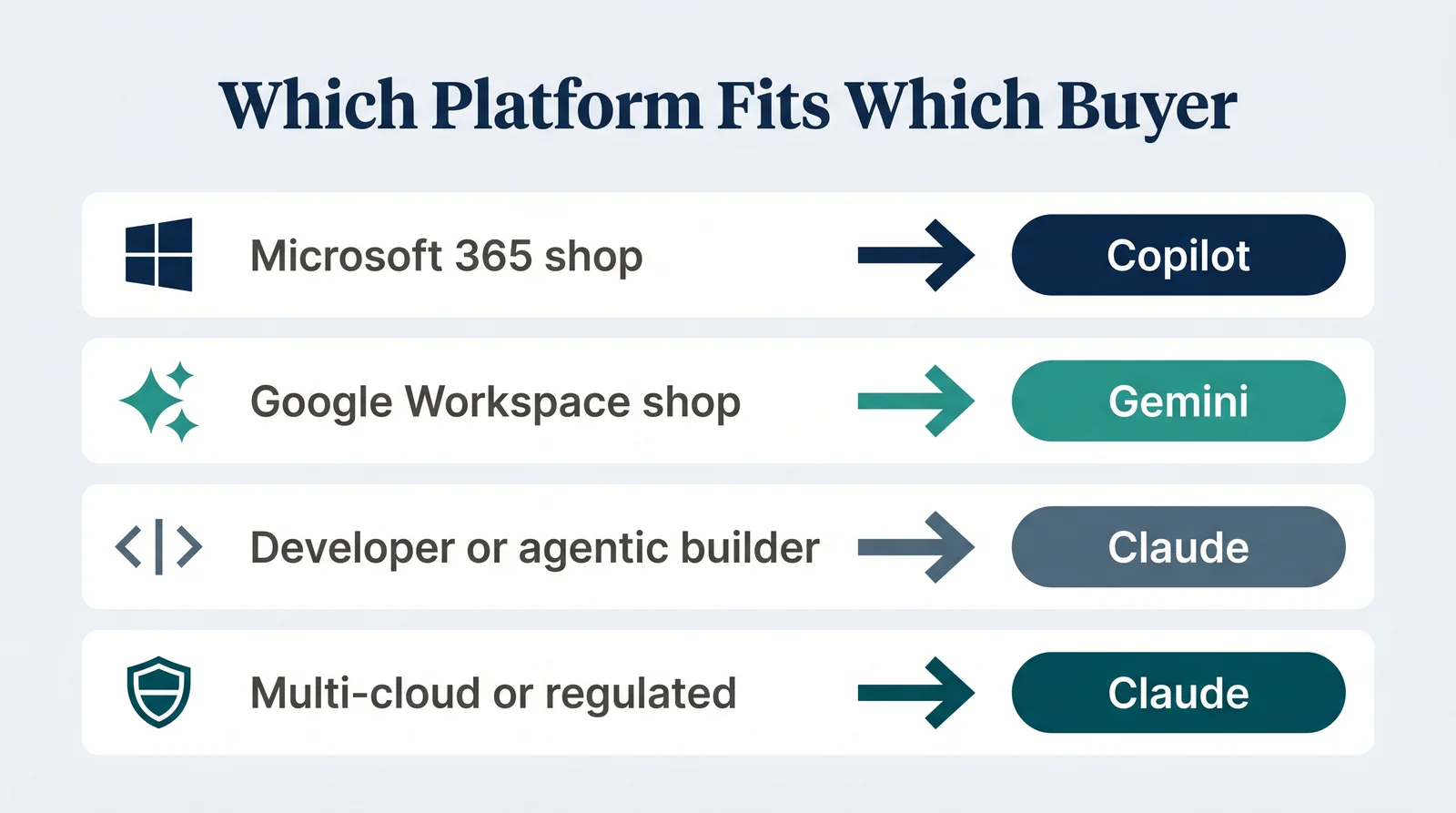
That single fact sorts most buyers cleanly:
- If Microsoft 365 is your workplace, Copilot usually wins. It is the only platform with first-party authorship inside Word, Excel, PowerPoint, Outlook, and Teams, grounded through Microsoft Graph in data the user can already see, with a unified governance plane in Agent 365. Claude cannot match that as a connector, and we will say so plainly.
- If Google Workspace is your workplace, Gemini holds the same home-field advantage inside Gmail, Docs, and Sheets, inheriting the same identity and data perimeter, and it is increasingly bundled into Workspace plans rather than sold as a separate seat.
- If you are building agents, automating technical workflows, or living in code, Claude leads. Anthropic created the Model Context Protocol, the open standard for connecting AI to tools that all four platforms have now adopted, and it backs that with a mature Agent SDK and Claude Code.
- If you are multi-cloud or regulated and want to avoid single-vendor lock-in, Claude leads again. It runs first-party and on Amazon Bedrock, Google Vertex AI, and Microsoft Foundry, carries ISO 42001 certification, and offers a FedRAMP High path through Claude for Government.
Two honest caveats keep this credible. First, Claude genuinely loses to Copilot and Gemini for an organization whose main want is AI inside its office documents. The native integration and permission-aware grounding are structural, not a feature gap Anthropic closes next quarter. Second, Claude is now selectable as a model inside both Copilot and Gemini. So “we want Claude” does not automatically mean “buy Claude Enterprise.” A Microsoft shop can often get Claude’s model quality through Copilot while keeping its native Office integration. The right answer is sometimes to run both.
On the capability that buyers over-index on, the context window: Claude Opus 4.8, the current recommended flagship, carries a one-million-token context at standard pricing, and Claude Fable 5, released June 9, 2026, is the most capable model in the lineup. Those are large numbers. They matter less than retrieval quality and permission-aware grounding for everyday work, which is exactly why Microsoft does not even publish a context-window figure for Copilot.
What greenfield buyers get wrong. Five mistakes show up again and again when an organization picks its first platform:
- Buying the model instead of the data layer. The differentiator is grounding, not benchmark scores.
- Underestimating the real per-seat cost. Headline prices hide stacking. Copilot is a base license plus the Copilot seat plus Copilot Studio credits plus Agent 365. Claude Enterprise is a low access seat plus usage billed at API rates, where usage becomes the true cost driver.
- Confusing “no training on our data” with “data never leaves our region.” Those are different promises. Inference location and storage residency are separate questions, and several platforms run inference in the US regardless of where data is stored.
- Ignoring permission hygiene. Copilot and Gemini surface anything a user can already access, so pre-existing oversharing becomes newly discoverable the day you turn AI on. Fix permissions first.
- Treating agent tooling as stable. The no-code agent builders are churning fast across every vendor. Build on the open standard (MCP) rather than a proprietary builder where you can.
The deployment surface decides your governance boundary
This is the section no competitor writes well, and it is the most important one. A clarification first, because it matters for precision: “Claude” is the name of Anthropic’s model family, and putting Claude models into production is not a single choice. You are choosing a surface, and the surface silently sets the limits of what you can govern. The same model behaves identically while the compliance envelope around it changes completely.
There are four surfaces plus the chat product, and they split into meaningful trade-offs (all of the following is documented in Anthropic’s data retention and Bedrock references):
- The first-party Anthropic API is the only surface that offers a HIPAA Business Associate Agreement and the
inference_geodata-residency control. It supports the full platform feature set. If you need a signed BAA, this is your surface. - Amazon Bedrock gives the strongest isolation. Inference runs entirely inside your AWS boundary with no Anthropic operator access, which is why it is the documented choice for FedRAMP High, DoD impact levels 4 and 5, and arrangements where AWS must be the sole data processor. The trade-off is real: Bedrock does not support several platform features, including server-side tools, Agent Skills, the MCP connector, and Managed Agents.
- Google Vertex AI puts Google in the processor role and offers EU regional endpoints for residency, with a reduced feature set similar to Bedrock.
- Microsoft Foundry is Anthropic-operated for access and billing and supports most Claude features, though not the Admin, Compliance, Models, or Batches APIs, and it caps Opus 4.8 at a 200,000-token context.
- The claude.ai Enterprise chat product is where most users actually work, and it is governed separately from the APIs (more on its retention limits below).
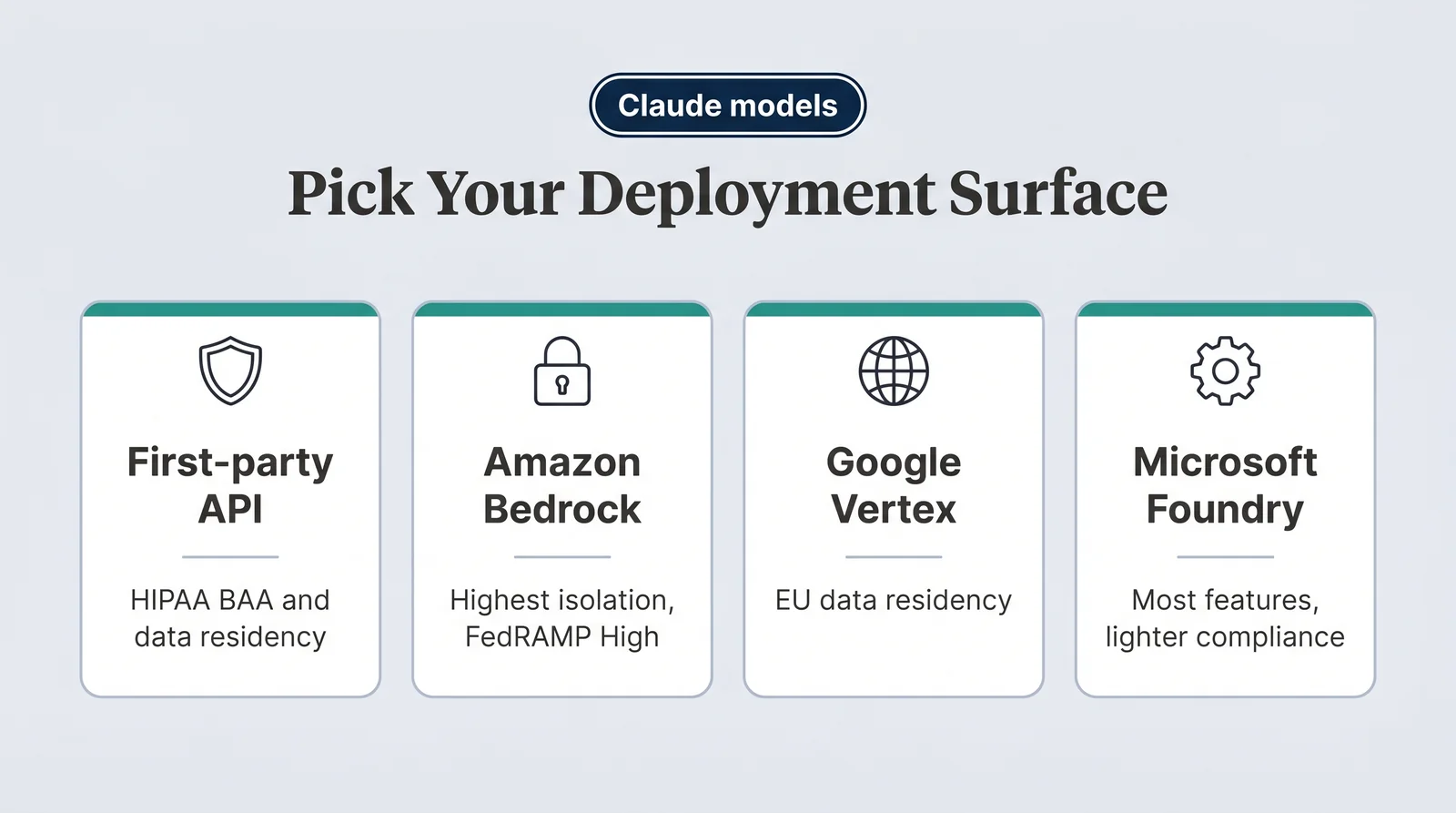
The takeaway is a discipline, not a default: there is no single most-secure surface. Choose it from the compliance requirement backward. A HIPAA workload points to the first-party API. A FedRAMP High or maximum-isolation requirement points to Bedrock. EU data residency points to Vertex or Bedrock EU regions. Decide the requirement first, and the surface follows.
Managing it: provisioning and administration
Claude’s enterprise administration is mature and, importantly, programmatic. The dividing line is between the Team plan and the Enterprise plan.
Team gives you single sign-on and domain verification with a small seat minimum, and it confirms no model training on your content by default. Enterprise adds the controls a governed deployment needs: role-based access control, SCIM provisioning, audit logs, a Compliance API, custom data retention, customer-managed encryption keys, US-only inference, and a HIPAA-ready configuration. As of mid-2026 the Enterprise model shifted toward a low per-seat access price plus usage billed at API rates, which means your real cost lives in consumption, not headcount. Confirm current pricing directly, since it has been moving.
The identity and oversight building blocks:
- Single sign-on uses SAML 2.0 through major identity providers, with the domain verified by a DNS record.
- Provisioning is handled by SCIM on Enterprise, with just-in-time provisioning available, plus domain capture to discover and migrate existing personal accounts on your domain inside a 30-day window.
- Access is governed by role-based permissions with built-in roles and custom roles on Enterprise.
- Oversight comes from a usage analytics dashboard, an Analytics API, and a Compliance API that exposes the activity feed and can feed your SIEM (Splunk, Datadog, and Cribl are supported). Standardize on the Compliance API rather than the narrower CSV audit-log export, which carries only a 180-day lookback and identifiers without content.
For teams using Claude Code, the most consequential governance feature is the managed settings file. It sits at the highest precedence, cannot be overridden by a user or even by command-line arguments, and fails closed. With it you can express policy as enforced rules instead of guidance: pin an approved model allowlist that cannot be widened, set a minimum and maximum version so the tool refuses to start outside an approved baseline, deny destructive commands, disable the permission-bypass and auto modes, and control which MCP servers are reachable through a policy file you push with Intune, group policy, or your MDM. This is the difference between a standard you documented and a standard you can prove is in force.
Governing it: the program layer
Tooling is not a program. The controls above need a governance layer wrapped around them, and this is the part regulated readers should read closely (and unregulated readers should right-size, per the note at the top).
Start with the answer to the question every procurement team asks first. Anthropic does not train its models on commercial, API, Team, or Enterprise inputs and outputs by default, and the 2025 consumer terms changes that introduced opt-in training explicitly do not touch the commercial terms. That is a clean, confirmable answer you can put in a vendor questionnaire.
From there, the program has four moving parts:
- An AI inventory tied to model lifecycle. Anthropic publishes a deprecation policy with at least 60 days of notice before a model is retired, moving through active, legacy, deprecated, and retired states, alongside a commitment to preserve the weights of released models. Put the model identifier and its retirement date in your inventory, because model churn is now fast enough that a pinned integration can break on a schedule you did not set.
- A pinned policy baseline. Anthropic’s Responsible Scaling Policy reached version 3.3, effective May 26, 2026. If your own AI governance documentation cites Anthropic’s RSP as an upstream control, pin the version and re-baseline when it changes. Citing a stale version is a finding waiting to happen.
- A verified certification list. Claude’s confirmed posture includes SOC 2 Type I and II, ISO/IEC 27001:2022, ISO/IEC 42001:2023 (the AI management standard), HIPAA via BAA, and GDPR through a data processing addendum, per Anthropic’s certifications page. FedRAMP High is real but reached through specific surfaces (Claude for Government, Bedrock GovCloud, and Vertex Assured Workloads), not the general commercial API.
- Restraint about what you claim. Do not assert certifications that are not on the primary source. ISO 27017, 27018, and 27701, CSA STAR, and NIST 800-171 appear in some third-party aggregators but not on Anthropic’s own certifications page. Verify against the live Trust Center before any of them goes into a customer-facing document.
Safeguarding sensitive data: the controls
This is where governance meets the keyboard. The following are the concrete levers a security team configures, and several of them correct a misconception that costs organizations real exposure.
Retention and zero-data-retention, honestly. ZDR is the control most often misunderstood. It is negotiated through sales and enabled per organization, not on by default, and it covers the Messages and Token Counting APIs plus Claude Code. It does not cover the Console and Workbench, Managed Agents, or the Team and Enterprise chat interfaces. The sharpest edge: Claude Fable 5 and Mythos 5 are covered models that require 30-day retention and cannot run under ZDR at all, so a ZDR organization calling Fable 5 receives an error. Even under ZDR, content flagged for policy or legal reasons can be retained for up to two years. For most governed deployments, the realistic posture is a 30-day custom retention floor, not zero.
Data residency. The first-party inference_geo control offers us or global values, with no first-party EU option, so EU residency runs through Bedrock or Vertex EU regions where the cloud provider is the processor. Confirm inference location, not just storage location, because they are different promises.
Data loss prevention. Be clear-eyed here: there is no Anthropic-native inline PII or DLP filter. Native sensitive-data masking comes from an AWS control, Bedrock Guardrails, or from an LLM gateway or CASB you place in front of the API. Anthropic does ship server-side prompt-injection probes that scan tool outputs and inject warnings, but that is input safety, not DLP. Plan your DLP approach explicitly rather than assuming the platform handles it.
MCP supply chain. When agents reach external tools, credential handling is the risk. Anthropic’s vault model injects secrets as write-only values through an Anthropic-side proxy after the request leaves the sandbox, so sandbox code cannot exfiltrate them even under a prompt-injection attempt. Vetting which third-party MCP servers you trust in the first place remains your responsibility.
Sandboxing. Agent environments run one isolated container per session. For production, set egress to limited, which is deny-by-default with an explicit host allowlist, rather than the unrestricted default. Note that Managed Agents and self-hosted sandboxes are not ZDR or HIPAA eligible, and that even a self-hosted sandbox still sends tool inputs and outputs to Anthropic’s control plane, because the model has to see results. It is isolation, not an air gap.
Refusals as audit evidence. When a safety classifier fires, the API returns a refusal with a stop_reason of refusal and a category such as cyber or bio. Pre-output refusals are not billed. Log these. They are machine-readable evidence that a control fired, which is exactly the kind of artifact an auditor wants to see.
Least privilege. Use the granular organization and workspace roles, provision service accounts through workload identity federation, and rely on the design choice that new API keys can be created only in the Console, not through the Admin API.
A pre-deployment readiness checklist
Pull the threads together into the sequence we use when scoping a Claude deployment:
- Pick the surface from the compliance requirement backward. HIPAA points to the first-party API, maximum isolation to Bedrock, EU residency to Vertex or Bedrock EU.
- Set the retention posture. Confirm ZDR eligibility, accept the 30-day floor, and note the model exclusions before anyone designs around zero retention.
- Stand up identity: SSO, SCIM, and least-privilege roles, then enforce the Claude Code managed settings for any team using it.
- Wire the Compliance API into your SIEM and start logging refusal categories as control evidence.
- Build the AI inventory: model, retirement date, and the pinned RSP version.
- Vet your MCP servers, set sandbox egress to limited, and choose your DLP or gateway approach deliberately.
For an unregulated organization, steps 1 through 3 are the ones that matter on day one. The rest scales up as your obligations do.
The work is configuration, not waiting
The platforms are all capable. That is settled. The differentiator is whether you can govern the one you choose and produce the evidence when someone asks. For Claude, the building blocks are already here: enforceable managed settings, programmatic compliance logging, vault-isolated credentials, sandboxed execution, and a clear, if narrower-than-advertised, set of data-handling controls. None of it is waiting on a roadmap. It is configuration, sequenced correctly, against the obligations you actually carry.
That sequencing is the work, and it is the work we do. If you are choosing your first enterprise AI platform, evaluating Claude, or weighing a move from Copilot, schedule a 30-minute scoping call and we will map the surface, the controls, and the readiness steps to your environment before you deploy.
Frequently asked
- Is Claude a good enterprise AI platform compared to Copilot and Gemini?
- It depends on where your work lives. Microsoft 365 Copilot and Google Gemini are embedded natively in their office suites and ground answers in permission-aware data (Microsoft Graph, Google Workspace), which is a real advantage for organizations centered on those suites. Claude leads on agentic depth (it created the Model Context Protocol now used across the industry), context window, model choice across multiple clouds, and data-handling flexibility. For development-heavy, multi-cloud, or regulated buyers, Claude is often the stronger fit. For a Microsoft-centric or Google-centric shop that mainly wants AI inside its documents, the native suite tool usually wins.
- Does Anthropic train on enterprise data?
- No. Anthropic does not train its models on commercial, API, Team, or Enterprise inputs and outputs by default, and the 2025 consumer terms changes that introduced opt-in training explicitly do not apply to commercial terms. This is the cleanest answer to the most common procurement question.
- What does zero-data-retention actually cover for Claude?
- Less than most buyers assume. Zero-data-retention (ZDR) is negotiated through sales and enabled per organization, not on by default. It covers the Messages and Token Counting APIs and Claude Code, but not the Console, Managed Agents, or the Team and Enterprise chat interfaces. Anthropic's newest models, Fable 5 and Mythos 5, require 30-day retention and cannot run under ZDR at all. Plan a 30-day retention floor as the realistic baseline for most governed deployments.
- Which Claude deployment surface should a regulated organization use?
- Choose the surface from the compliance requirement backward. The first-party Anthropic API is the only surface with a HIPAA Business Associate Agreement and the inference_geo data-residency control. Amazon Bedrock gives the strongest isolation (data stays in your AWS boundary with no Anthropic operator access) and supports FedRAMP High and DoD impact levels, but drops some platform features like server-side tools and Managed Agents. There is no single most-secure surface; it is a trade-off between isolation, feature access, and compliance scope.
- Do smaller or non-regulated businesses need all of this governance?
- No. The data-handling and deployment-surface decisions are table stakes for everyone, but the formal certification, audit-evidence, and compliance machinery is written for organizations that answer to regulators. A smaller or unregulated business should right-size its program to the obligations it actually carries rather than building the full apparatus on day one.